

Amazon Echo Sub, Powerful subwoofer for your Echo, Requires compatible Echo device
$129.99
Related Products


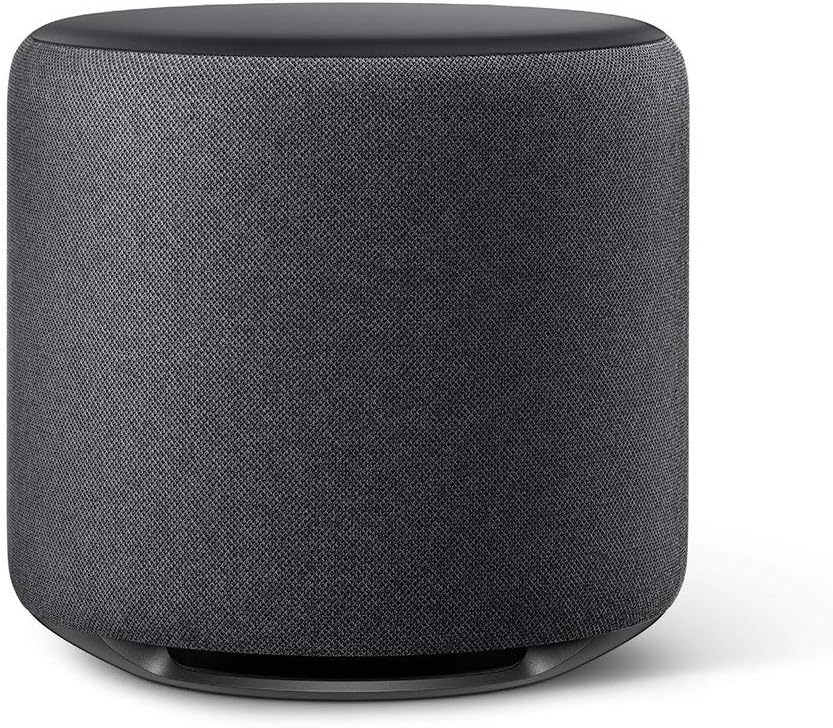


Echo Sub delivers down-firing, deep bass sound through a 6″ woofer.
Pair with one compatible Echo device to enjoy dynamic music that fills the room.
Pair with two of the same compatible Echo devices for rich left/right stereo sound.
Create an Alexa Home Theater by pairing Echo Sub and up to five compatible Echo speakers and your compatible Fire TV device.
Simple to set up and use—just plug in, open the Alexa app, and wirelessly connect to your Echo device(s) to control music with your voice.
3 reviews for Amazon Echo Sub, Powerful subwoofer for your Echo, Requires compatible Echo device
Show all
Most Helpful
Highest Rating
Lowest Rating
Add a review
Amazon Echo Sub, Powerful subwoofer for your Echo, Requires compatible Echo device
$129.99
Higbe –
Terrific Performance
Amazon Echo Sub-WooferWhere do I start? At this point I am here to say this is a GREAT product, well worth the money.Five Stars for sure.But I digress…I started out with an Amazon Echo, first generation, paid nearly $100 for it, but was quite pleased with its performance. I was very pleased with the sound output of that small device. I liked it so much I bought another for another room. Being an Amazon Prime member, I started listening to music from Amazon. Again, pleased – and I decided to add the unlimited subscription to Amazon Music.I have a traditional stereo system – two speakers, an amplifier, and a CD player. I got to thinking I would like to feed the Amazon music into the stereo and researched the subject on the internet. Turned out to be stupidly simple. I bought a third generation Dot, now less than $50, and a simple adapter cable. The cable plugged into the output jack of the Dot and into the right and left stereo inputs on my amplifier. I had to do a little volume adjustments of the Dot and of the stereo amp to get the levels right – but that was a five minute exercise, and suddenly I had beautiful music in full stereo.But in researching the stereo bit, I discovered something else interesting on the internet – that it was simple to set up two identical Echo units to give full stereo. Well, I have two identical first generation Echos. So I tried it, setting up in a different room. A note here – it is unlikely that most of us could ever set a stereo pair up without some very simple instruction from the internet. You have to use the Amazon app on a smart phone. But with that instruction it is a very simple exercise. I did it. And it sounded great.And that’s also about when I discover the existence of the Amazon Echo Sub-Woofer. OK. I admit at first I was skeptical. How could a six inch diameter speaker generate significant base? But then how could a tiny Amazon Echo Dot sound so terrific? But they do.The gold standard for bass performance for many is the piece, “Thus Spake Zarathustra” by Richard Strauss. To quote Wikipedia, “The piece starts with a sustained double low C on the double basses, contrabassoon and church organ.” This corresponds to a tone of some duration at a frequency of 32 hertz. Only higher end classic stereo systems will deliver this tone. In most, it plays as a low level buzz that would be obnoxious were it any louder.So OK. I pulled up the specs on the unit. Hmm. Goes to 30 hertz at minus 6 db. You know, that ain’t bad! And you could goose up the low end a bit with the equalizer in the Amazon app. The built in 100 watt amplifier and cross over network built into the sub-woofer help a lot. Hmm. OK, I went ahead and ordered it. And immediately discovered that at the time there was a 4 week wait for delivery.The unit did show up as promised, and I was anxious to get it going. A comment here: normally I am rather contemptuous of “unpacking” videos on the internet. But, the packing and packaging of this unit is a performance art master class on how it should be done. I will say no more on that subject except that I was hugely impressed.Setting it up was mostly easy – but NOT as easy as the Amazon site suggests. The main issue is that if you integrating it into an existing stereo pair of Echo units, as I was, first you have to unpair the existing units, then rebuild with the addition of the sub-woofer. Very simple to do on the app – but NOT intuitive. Again, the internet is your friend. I easily found simple instructions and proceeded – and five minutes later had everything networked and playing.It sounded OK, but honestly not all that terrific. Certainly not what I was expecting. Playing “Thus Spake Zarathustra” was, frankly, disappointing. But, I have had experience with base woofers before, and had a suspicion it wold improve. It seems such speakers need to be used a bit to loosen up to reach their desired performance levels.I am very happy to report that this proved to be exactly the case. After a few hours, the speaker was clearly doing better. A few days and it was sounding great. And today, I was sitting in my chair listening to Hans Zimmer’s sound track for “The Dark Knight”, a piece I had played several times before. But this time, it seemed like the whole room was shaking from an outstanding base source. I was astounded – and hugely delighted! I am truly pleased.A closing note – truly serious audiophiles are guaranteed to turn up their noses at this system. I am talking about the people that only use virgin vinyl records for a music source, heavy oxygen free copper cables to the tube amplifier with heavy iron transformers, huge engineered bass reflex speakers or the like etc. etc. Good for them – and perfection has its price. But for us lesser mortals who love music, the Amazon system offers a quality system offering a lot of pleasure at a modest price.
C. Carroll –
A great sub for an Echo/Amazon ecosystem.
For its cost and use with Echo devices, this is a good subwoofer. I considered giving it a 4 out of 5 but only because of how long it took for my Fire TV Stick 4K Max took to recognize the device. Despite how long it took, I was patient and it eventually recognized it hours after the sub was connected to my wifi. This was the only issue. I was also familiar with this issue since I have two of these subs, so I knew what I was getting into – it’s not at all a deal breaker. Once the device is setup, you’re mostly all set.My first Echo Sub is connected with two 1st Gen Echo Studios using a gen 3 Fire TV Cube. The sound is very good on this system.The 2nd Echo Sub was added to 5 2nd Gen Echo Studios connected to the 4k Fire TV Max Stick for the maximum new theater setup. Overkill? No. The added bass works very well and doesn’t over do it on the low end.When listening to music, it’s easy to adjust the bass in the Alexa app if there is too much bass. As mentioned before, this isn’t usually an issue, but the option is there. Music sounds great with the sub. For movies, the bass adds a very nice dynamic that im glad is part of the theater system. The two generations of Echo Studios DO have good bass, but the added sub brings a noticeable difference that makes the addition worth it.Echo speakers with an Echo Sub isn’t a top of the line sound system. However, it’s really good for the price you pay. I’ve read many reviews of Sonos speakers having connection issues and I already have the Amazon music unlimited subscription and prime membership, so it was a no brainer. This isn’t to knick on Sonos as I’ve also heard great things, but with everything considered, I went with Echo devices. My Echos sound great and adding the sub makes a positive difference.
Floyd B. –
Incredible Improvement to the Listening Experience within the Echo-Sphere
I ordered the sub during the promo, bundled with two 2nd-gen Echos. Setting up the “trio” (can’t call it a speaker “group”, since that term has a very specific meaning in Echo-land), I had some difficulty during the initial setup, but realize in retrospect that I should have powered up the new Echos by themselves first, and let them perform the online software update. Once I did that, the second time I tried to create the 2.1 “trio”, the process went almost flawlessly.As others have said elsewhere, the instructions accompanying the unit are severely lacking — just shy of useless. If you’ve configured the full range of other Echo devices (we have over 30 just in our primary house), it’s fairly easy to navigate the new setup features for creating and pairing the three devices into the “trio”. Having had Echo devices since the very first early-order days nearly three years ago (I even have echo dots in all of my vehicles), the Alexa app and the configuration processes for new devices as they came to market have evolved dramatically. So in some way it’s understandable that the setup instructions — for any of the Echo devices — has to be somewhat vague, since the setup processes are also constantly evolving, and specific setup instructions in the box of the device you buy today may be totally irrelevant and even more frustrating should you try setting up the same device 6 or 12 months later.The sub creates such a vast improvement in the sound experience that it’s hard to describe it accurately. My biggest complaint is that the bass can be overpowering in some room environments. The room I chose to install the “trio’ in is a 14ft x 14ft room with uncovered, polished hardwood floors, and otherwise sparsely furnished. With certain types of music (I like loud, bassy music, like vocal trance and EDM), the bass can be so intense that it actually vibrates the windows, and overpowers the mids and highs coming from the individual Echos. To compensate, the only option is to use the equalizer for the “trio” and dial down the bass, but this also reduces the bass coming from the Echos themselves. I’d like to hear more bass from the Echos, but can’t because of having to dial down the low frequency equalizer slider in order to lower the drive to the sub, just to make the listening experience more balanced (and enjoyable). As a practicing audio and RF engineer, it seems to me that a very quick and easy fix to my specific problem (and I’m sure others) would be to have a configuration setting for the sub only that allows you to “dial in” a certain amount of attenuation to the bass drive. A simple set of selections in steps of 3 db (up or down, depending on your individual setting) would be a perfect quick fix for this In my case. The fact that the room is basically a flattened cube, it’s easy for the sub to deliver sounds that match the natural resonant frequency of the room. The better (long-term?) fix for this kind of problem would be to have a separate equalizer function for only the sub, to configure the response of only the frequencies the sub is designed to produce. A 3- or 5-band equalizer would essentially allow me “dial down” the band of frequencies that tend to resonate in the room. A fantastic fix to this type of problem.Having watched Amazon’s evolution of fixes and improvements to the individual Echo devices, as well as to the Echo-sphere overall, I have to believe that they’ll eventually be able to configure a 2.1 “trio” to participate in a system group as though it was a single device entity. Seems like it should be a a basic software upgrade issue. The same with the ability to support audio inputs other than just streaming services (as I see it, if you want to bluetooth a stereo signal to your Echo(s) from your phone or other device, Amazon would have to develop the ability to allow you to make a bluetooth connection to an Echo stereo pair first. Once that feature works, it might then be possible to add the sub to the stereo pair for the 2.1 config (still not sure if the sub has to grab the audio stream via WiFi first for the “trio” to actually function).Regarding the disappointment that so many people are expressing regarding the limited Bluetooth functionality, it seems that their expectations were misplaced. When I read the early product release announcement, it was clear to me that the Sub was specifically intended to work with only a subset of Amazon-specific Echo devices. But after re-reading the promotional info on Amazon’s web site regarding the Sub, there is definitely some ambiguity about it’s intended configuration limitations. I would strongly recommend to Amazon that they re-write the capabilities and features sections regarding the Sub so that there are NO ambiguities regarding exactly what the Sub is and is not intended to do or capable of, or how it is intended to operate.Lastly, I wish Amazon would introduce a “big sister” version of the Echo with more power, making them a better match to the capabilities of the Sub. It seems that the Sub is definitely in a power/performance class that is a notch above the capabilities of the current Echos.AS a final comment, I would have gladly given the Echo Sub 5 stars if the drive level to the Sub could be controlled independently from the equalizer profile for the Echos.